Back to Home to display all posts.
Showing posts with label DevOps. Show all posts

10/10/2025

Enrich Docusaurus search - Algolia DocSearch

Here is another story of why I always advise DevOps Engineers to have T-Shaped skills to enhance any step in the software production!

A cross-functional team gathered during a Kaizen Event to enhance the Camunda documentation for the remarkable Camunda 8.8 release. Besides the content, I worked on some enhancements of the search functionality to provide the best experience when using the official documentation (for the end users and developers as well).

TL;DR

The main 3 enhancements are:

  • Updated the DocSearch Crawler config for better search results (that's actually the most critical fix; we had an old config that led to bad search results).
  • Supported custom page rank, so we can set important pages to show first (we know our docs better than the indexing algorithm!).
  • Showed the page breadcrumb paths for better search navigation and usability (a small UI change but huge UX impact!).

As Camunda works in public, you can see my pull request in the Camunda Docs repo with all changes 🚀

1. Overview

Docusaurus is one of the famous static content management systems, which helps you to build documentation websites, blogs, marketing pages, and more. It's widely used for documentation by many companies and open-source projects (I even used it in the Dynamic DevOps Roadmap).

Docusaurus search support mutliple options like Algolia DocSearch, Typesense DocSearch, Local Search, etc. Each search module has a different configuration, and your project's search results could be affected by the module's configuration.

2. The Problem

Camunda documentation utilizes Algolia DocSearch; however, at a certain point, the search returned generic results, important pages were buried, and even if you're certain the content is there, you can't find it via the search.

3. The Solution

To get quick and solid results, I've narrowed down scope the focus area to 3 pain points:

  • How to show better search matching.
  • How to show important pages first, regardless of the indexing algorithm.
  • How to show the page path in the search dialog (because many pages could have the same title but under different sections).

3.1 DocSearch Crawler Configuration

As mentioned, the search matching was poor, but it worked well at a certain point in the past. That's a typical signal of an upgrade issue.

And, as usual, always read the documentation! Directly I've found that the DocSearch crawler configuration has some issues and it doesn't match the DocSearch official recommendations for Docusaurus v3.

That fixed most of the bad search matching because the index created by the crawler was misconfigured.

3.2 Custom Page Rank

We know our product better than any indexing algorithm, so for some pages, we know they are more critical than others and should appear first for certain keywords.

For that, I introduced a method to set the page rank from the pages Front matter which requires 2 changes.

First, a change in the index template src/theme/DocItem/Metadata/index.tsx to parse the front matter and add it as metadata:

// TypeScript Execute

// Get the page rank from front matter, defaulting to 0 if not set.
// Higher page rank means higher priority in search results.
// This is parsed by Algolia's crawler to prioritize search results.
const pageRank = currentDoc.frontMatter.page_rank || 0;

return (
    <>
        <Metadata {...props} />
        <Head>
        <meta name="docsearch:page_rank" content={pageRank} />
        </Head>
    </>
);

Second, updated the DocSearch Crawler configuration to use that metadata in the indexing:

// JavaScript
new Crawler({
  // [...]
  actions: [
    {
      // [...]
      recordExtractor: ({ $, helpers, url }) => {
        // Page rank.
        // Use the page rank from the Docusaurus frontmatter if available, if not
        // calculate it based on the URL depth.

        // Extracting the page rank from a meta tag (it's set by the Docusaurus pages frontmatter).
        const pageRank = $("meta[name='docsearch:page_rank']").attr("content");
        // Set default page rank based on the number of slashes (ignore trailing slash).
        // Set pageRank as inverse of depth, fewer slashes = higher rank.
        const path = new URL(url).pathname.replace(/\/$/, "");
        const depth = path.split("/").filter(Boolean).length;
        const maxDepth = 12; // Depth cap.
        const defaultPageRank = Math.max(0, maxDepth - depth);

        return helpers.docsearch({
          recordProps: {
            pageRank: pageRank || defaultPageRank,
            // [...]
          },
        });
      },
    },
  ],
);

Now, on any page, if the rank is not set, it will rely on the page depth; otherwise, the team can set the page rank for the important pages in the front matter like this:

<!-- Markdown -->
---
sidebar_label: Kubernetes with Helm
title: Camunda Helm chart
page_rank: 80
---

The page content goes here...

3.3 Page Breadcrumb Path

By default, the DocSearch official recommended template for Docusaurus v3 doesn't display the page hierarchy in the search window.

The issue arises from the fact that many projects are hierarchical, and the same page title could be listed under different sections (e.g., for setting up a specific task using Helm or AWS EC2 instances, the first is categorized under Kubernetes and the second under Amazon as a cloud provider).

For a better navigation and usability, I included the page path in the Algolia search index. The idea is simple; it requires 2 changes.

First, ensure the breadcrumbs config is enabled (it's enabled by default).

Second, include the page breadcrumb path in the level 0 in the DocSearch Crawler configuration so it shows in the search:

// JavaScript
new Crawler({
  // [...]
  actions: [
    {
      // [...]
      recordExtractor: ({ $, helpers, url }) => {
        // Extracting the breadcrumb titles for better accessibility.
        const navbarTitle = $(".navbar__item.navbar__link--active").text();
        const pageBreadcrumbTitles = $(".breadcrumbs__link")
          .toArray()
          .map((item) => $(item).text().trim())
          .filter(Boolean);
        const lvl0 = [navbarTitle, ...pageBreadcrumbTitles].join(" / ") || "Documentation";

        return helpers.docsearch({
          recordProps: {
            lvl0: {
              selectors: "",
              defaultValue: lvl0,
            },
            // [...]
          },
        });
      },
    },
  ],
);

And the result is that the page path shows in the search window (TBH, this should be the default! So I've created a pull request to include it in the DocSearch repo):

4. Conclusion

As a DevOps Engineer, your focus should always be on the end-to-end software production process, with a customer-centric approach, not just a part of the process. For that reason, you should possess T-Shaped skills that enable you to handle any case and improve the UX on all levels.

I already discussed why your DevOps learning roadmap is broken and what to do about it.

Happy DevOps-ing :-)

Continue Reading »

03/03/2025

Research Paper: Building a Modern Data Platform Based on the Data Lakehouse Architecture and Cloud-Native Ecosystem

Building a Modern Data Platform Based on the Data Lakehouse Architecture and Cloud-Native Ecosystem

Finally, after months of hard work, I have published my first research paper in a double-blind peer-reviewed scientific journal by the international publisher Springer Nature 🙌

The paper is titled:

Building a Modern Data Platform Based on the Data Lakehouse Architecture and Cloud-Native Ecosystem

This research paper is the result of several months of work and is based on my master's thesis, which was published in 2023 (I got Master of Science with Distinction in Data Engineering from Edinburgh Napier University).

The paper presents a practical application for data management without vendor lock-in, in addition to ensuring platform extensibility and incorporating modern concepts such as Cloud-Native, Cloud-Agnostic, and DataOps.

Why is this paper important? Because data is the backbone of Artificial Intelligence! In today's world, control over data means political and economic independence.

I would like to extend my sincere gratitude to the research team who contributed to this work, supported me, and shared their knowledge to help bring this paper to the highest quality. It was a truly enriching experience on many levels! 🙌

  • Dr. Peter Barclay: Head of the Data Engineering program at the School of Computing, Edinburgh Napier University.
  • Dr. Nikolaos Pitropakis, PhD: Associate Professor of Cybersecurity at the School of Computing, Edinburgh Napier University.
  • Dr. Christos Chrysoulas: Associate Professor in Software Engineering at Heriot-Watt University.

The research group chose these quotes from our respective languages/cultures to emphasize the importance of perseverance and diligence:


عِندَ الصَّباحِ يَحمَدُ القومُ السُّرَى
(In the morning, the people praise the night's journey)
Arabic Proverb

Αρχή ήμισυ παντός
(The beginning is half of everything)
Greek Proverb

Is obair latha tòiseachadh
(Beginning is a day's work)
Scottish Gaelic Proverb


I will write a community blog post about it soon :-)

Continue Reading »

22/02/2025

How Open Source Helped Me Step Up My DevOps Career - Presentation

2 days ago (20.02.2025), it was a pleasure to participate in the Open Source Summit 2025 in KSA.

My session was about participating in Open-source and how it helps to be a better DevOps engineer. In fact, the best DevOps engineers I have encountered possess T-shaped skills that require diving into many areas, even outside of the daily work topics.

How Open Source Helped Me Step Up My DevOps Career

It was nice to reflect on all those years of professional work and open-source contributions 🤩

Continue Reading »

31/12/2024

2024 Highlights

Finally, 2024 is over! Another crazy year but I like it! 🤩 This year was a bit chill compared to previous ones, but also I did many new things.

Top 5 highlights in 2024

1. Career

In 2022, I formed the Distribution team at Camunda, which is responsible for building and deploying the Camunda Platform 8 Self-Managed, which is an umbrella Helm chart with 10+ systems. In 2023, the main mission was to increase the team size to 4. In 2024, the onboarding was done for all members, and the team became more autonomous and worked at full capacity. I like the process of building and leading the team and am excited for the next steps in 2025. 🤩

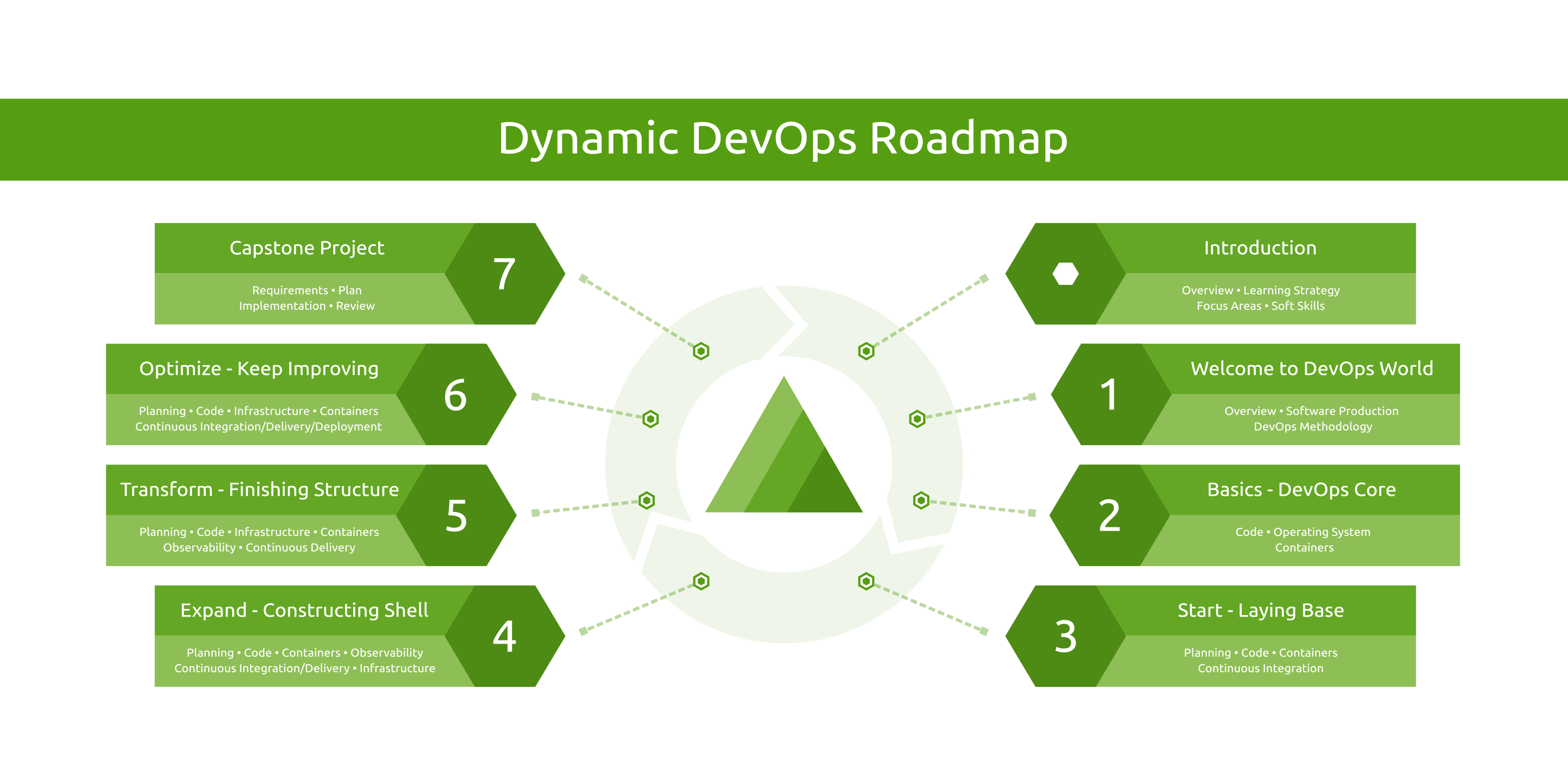
2. Dynamic DevOps Roadmap

Dynamic DevOps Roadmap

In 2023, I wrote why the DevOps linear roadmaps are broken by default and then sow the seed of the Dynamic DevOps Roadmap to become a DevOps Engineer.

In 2024, I finished 100% of the roadmap and launched the roadmap website, making reading and following progress much easier. I'm pretty happy that many people like the approach of that roadmap instead of other roadmaps that list tons of DevOps tools! (which doesn't really work!). Here are some other highlights:

  • The roadmap repo got more than 1.6k stars on GitHub.
  • Added around 250 quiz questions (embedded in each module).
  • Added around 200 general interview questions.
  • Added interview best practices, which are the same as important as technical skills.
Experience-Driven DevOps: Beyond Tools, Where Concepts Meet Real-World Challenges

A FREE pragmatic DevOps roadmap to kickstart your DevOps career in the Cloud Native era following the Agile MVP style! A DevOps Engineer or Software Engineer, this roadmap is all that you need to start, grow, and expand!

3. Public Speaking

This year, I conducted some nice sessions (in Arabic) with awesome people.

As usual, JobStack_ continues to set the bar higher each year! It is an unmissable event for tech enthusiasts. I really enjoyed participating as both a speaker and a listener. 🤩

In November, I had 2 sessions, the kick-off and another specialized in DevOps.

Also, in December, I participated in a live podcast with Ahmed Elemam covering ⭐ How to start with the Dynamic DevOps Roadmap.

4. Activities

Besides these highlights, I had some nice stuff during the year. For example:

  • Updated my main website aabouzaid.com, listed my projects, blog posts, publications, tech talks, and more.
  • Traveled to 3 countries, Oman, Saudi Arabia, and Dominican Republic to attend tech and work-related events. I also had the chance to meet a lot of friends in those travels. Saudi Arabia wasn't my first time there, but the last time was too long ago, happy to be back again. 🤩
  • After 5 years of OnePlus 6, I got a new phone. First, I tried for a couple of months Samsung Galaxy S23 Ultra, a great device but super heavy! So I swtiched to Samsung Galaxy S24, which is high-quality and perfect in size.
  • Since 2020, I've been using the ergonomic mouse (standard vertical) and keyboard (Microsoft Sculpt) and totally like them. Recently, I changed the mouse to Logitech MX Vertical. It's pretty good for me; my only concern is that the clicks are a bit noisy!
  • Lost some weight, which is great 😄

And since we are on this topic, here are the top 5 visited blog posts in 2024!

Top 5 posts in 2024

  1. 2 ways to route Ingress traffic across namespaces - Kubernetes
  2. How to create Makefile targets with dynamic parameters and autocompletion - Make
  3. Validate, format, lint, secure, and test Terraform IaC - CI/CD
  4. Your DevOps learning roadmap is broken! - Career
  5. 3 ways to customize off-the-shelf Helm charts with Kustomize - Kubernetes

Almost the same as last year, 2023, DevOps, Kubernetes, and Kustomize posts are still in the top.

What's next?

As usual, I don't plan the whole year in advance, I just put some high-level directions then work on them as I go in Agile iterative style (yes, I use Agile for personal goals too).

What I know, I will focuse on growing the Dynamic DevOps Roadmap community and work on the Career Growth and Advanced Topics section.

Previous Years


Enjoy, and looking forward to 2024! 🤩

Continue Reading »

06/06/2024

31/12/2023

2023 Highlights


Image generated with Craiyon.

Finally, 2023 is over! What a year! One more crazy year, but it was the culmination of many actions I've started previously.

Starting with the fun facts ... this is the post no. 100!

After 9 years of tech blogging in English (I had another 10 in Arabic before that). It should be 108 posts since the plan was to post 1 per month, but I missed some, still not bad!

Top 5 highlights in 2023

1. Career

Image by vectorjuice on Freepik

In 2022, I formed the Distribution team at Camunda which is responsible for building and deploying the Camunda Platform 8 Self-Managed which is an umbrella Helm chart with 10+ systems. In 2023, the biggest challenge was increasing the team headcount to 4 and building the workflow to handle that!

2. Academia

I've always been into data! So in 2020, I started a part-time master's in Data Engineering at Edinburgh Napier University. After almost 3 years, I was awarded a Master of Science with Distinction in Data Engineering 🎉. In June, I got the result after I successfully defended my dissertation titled Modern Data Platform with DataOps, Kubernetes, and Cloud-Native Ecosystem. Then in October, I traveled to Scotland to attend the graduation ceremony. All I can say today is that it was a great experience by all means! (and that's actually why I had some unusual gaps in blog posts in 2023 because I was working on the master's thesis).

3. Mentorship

Dynamic DevOps Roadmap

In the last 5 years, I mentored many people in different career stages (starting their first job, career shift, moving to another work style or company). Almost every day, I see people struggling on their way to the DevOps field. I already wrote why the DevOps linear roadmaps are broken by default! So I decided to fix that and launched a Dynamic DevOps Roadmap to become a DevOps Engineer which under the DevOps Hive identity! The nice thing that I saw many people already like the idea and want to do it that way!

ℹ️ Check out the Dynamic Roadmap content ℹ️

4. Public Speaking

Jobstack is one of my favorite tech events all the time! And as usual, this year was awesome! As a speaker, I had 2 sessions, and as an attendee, I enjoyed many sessions on different topics.

5. Activities

Besides these highlights, I had some nice stuff during the year. For example:

And since we are on this topic, here are the top 5 visited blog posts in 2023!

Top 5 posts in 2023

  1. 2 ways to route Ingress traffic across namespaces - Kubernetes
  2. Validate, format, lint, secure, and test Terraform IaC - CI/CD
  3. Your DevOps learning roadmap is broken! - Career
  4. Delete a manifest from Kustomize base - Kubernetes
  5. 3 ways to customize off-the-shelf Helm charts with Kustomize - Kubernetes

The same as last year, 2022, Kustomize posts are still in the top; that's because there is not much content about it even though it's built-in kubectl now! (since v1.14). That's why I created a Kustomize Awesome list, which is a curated and collaborative list of awesome Kustomize resources.

But this year, 2023, for the first time, a blog post posted in the same year appears in the top 5 posts! Which is discussing how the linear DevOps learning roadmap is broken by default! That's why I had a follow-up post showing the solution that suggests a better way to Become a DevOps Engineer with the Dynamic DevOps Roadmap. ⭐

What's next?

As usual, I don't plan the whole year in advance, I just put some high-level directions then work on them as I go in Agile iterative style (yes, I use Agile for personal goals too).

What I know already is that I need to reward myself and take a good break after the master 😁

Also, I want to put more effort to grow the DevOps Hive community to help more people to land their first DevOps Engineer role!


Enjoy, and looking forward to 2024!

Continue Reading »

12/12/2023

Become a DevOps Engineer with the Dynamic DevOps Roadmap - Career

Dynamic DevOps Roadmap

A couple of months ago, I discussed why all linear DevOps learning roadmaps are broken by default (like roadmap.sh/devops)! In that post, I've discussed the issue, where it comes from, and the solution I tried for over 5 years!

The solution is simply switching to an MVP-style learning roadmap where you learn in iterations and touch multiple parts simultaneously (not necessarily equally). Each iteration should focus on a primary topic while exploring related side topics. So after a month, you already know about each topic in the roadmap, and after the 2nd month, you have the basics, and after the 3rd month, you have a good base, and so on.

Based on my mentorship experience in the last 5 years, I've concluded that any "tool-based" approach to deal with DevOps will fail miserably. The Cloud-Native landscape is getting bigger and bigger every day, and there is no way to deal with it that way.

For that reason, I've reviewed all docs from the previous mentorship docs I held in the past (I worked with people starting their first job, career shift, or moving to another work style or company) and built the ultimate missing solution!

⭐ Check out the Dynamic Roadmap content ⭐

This roadmap is polymorphic, which means it's designed to work in different modes. It depends on how fast you want to go.

  1. Self-Learning Course: In this mode, you are not expected to have DevOps experience, and you want to go from zero to hero, transforming your knowledge to land your first job as a DevOps Engineer.
  2. Hands-on Project: In this mode, you have some experience with DevOps (usually between 1-2 years of work experience), but you want to step up your skills with real hands-on industry-grad projects to learn DevOps in a pragmatic manner.
  3. Mentorship Program: In this mode, the previous two modes are covered (that means it could be only for the project or the whole roadmap) but with support from a mentor! The project will provide you with a DevOps expert who will guide you in following up on your progress and personalizing your learning plan.

The whole idea is about the Learning by Doing method (aka Problem-based Learning), which is done in iterative phases where you learn as you go and cover the whole DevOps cycle like Code, Containers, Testing, Continuous Integration, Continuous Delivery, Observability, and Infrastructure.

The project is a work in progress; more details are in the status section.

I hope that the project helps more people start their DevOps engineering careers! The market is thirsty for it already!

⭐ Check out the Dynamic Roadmap content ⭐

Happy DevOps-ing :-)

Continue Reading »

12/11/2023

DevOps is not only a culture - Discussion Panel

Today is my second session JobStack 2023 after my previous one yesterday titled "Platform Engineering: Manage your infrastructure using Kubernetes and Crossplane", but this time it was a discussion panel with Ahmad Aabed (CTO of Zyda).

For a long time, DevOps methodologies have been the driving force behind innovation and efficiency in modern software development. You've likely encountered the popular jargon: "DevOps is not a role; it is a culture"! However, the truth is that DevOps has much more!

This session dives deep into the pillars world of DevOps, going beyond the cultural aspect to explore practices, technology stacks, mindset, and more. This is an open discussion where we will share (and encourage you to do so) the experiences of implementing DevOps. In other words, what practical steps have you taken to embrace the power of DevOps in your organization?

A shot from the recoding

At the end, I'd like to share a couple of posts I wrote before in that regard (DevOps methodologies in action):

Enjoy :-)

Continue Reading »

11/11/2023

Platform Engineering: Manage your infrastructure using Kubernetes and Crossplane - Presentation

Just fresh out of the kitchen, part of JobStack 2023, today I conducted a session about a great tool ... Crossplane, the open-source control plane!

I've been using Crossplane for over a year and a half, and it helped me a lot to manage my infrastructure without the need to use Terraform (I still love Terraform, but it wasn't the best for my use case).

In this session I shed the light on how Crossplane could unify infrastructure management within Kubernetes.

I gave a brief how Crossplane extends the functionality of Kubernetes and allows you to create external infrastructure. You can create Cloud resources the same way you create Kubernetes resources! I really love its declarative, cloud-native, GitOps-friendly approach to code-driven infrastructure management.

Agenda:

  1. Scenario
  2. What is Crossplane?
  3. How it look like?
  4. Crossplane Concepts
  5. How Crossplane Works
  6. Pros and Cons
  7. Conclusion
  8. Resources
  9. Questions

Note: For more resources, checkout this Awesome Crossplane list.


A shot from the recoding 🙌
Watch the full session on YouTube: Platform Engineering: Manage your infrastructure using Kubernetes and Crossplane (Arabic)

Conclusion:

Crossplane is a great framework for managing infrastructure using the Kubernetes style and benefits from the that ecosystem (ArgoCD, Helm, Kustomize, etc.).

There are many use cases where it can perfectly fit in already. And at the time of writing these words (November 2023), the Marketplace has numerous enterprise and community providers configurations. Also, Composition Functions graduated to beta.

However, it's a relatively new ecosystem and still evolving, so it might not be the optimal solution for every workload. But it's probably a matter of time to grow more. So, if it's not your fit now, consider revisiting in the future.


That's it, enjoy :-)

Continue Reading »

07/07/2023

My Master's Dissertation: Modern Data Platform with DataOps, Kubernetes, and Cloud-Native Ecosystem

Almost 3 years ago (September 2020), I enrolled in a part-time master's program in data engineering at Edinburgh Napier University. Finally, two weeks ago, I got an email informing me that I successfully completed my master's and the program board of examiners awarded me Master of Science with Distinction in Data Engineering 🎉🎉🎉

My graduation ceremony would have been today, but I postponed it to October 2023 for some personal matters. So it's just a matter of time till the official graduation.

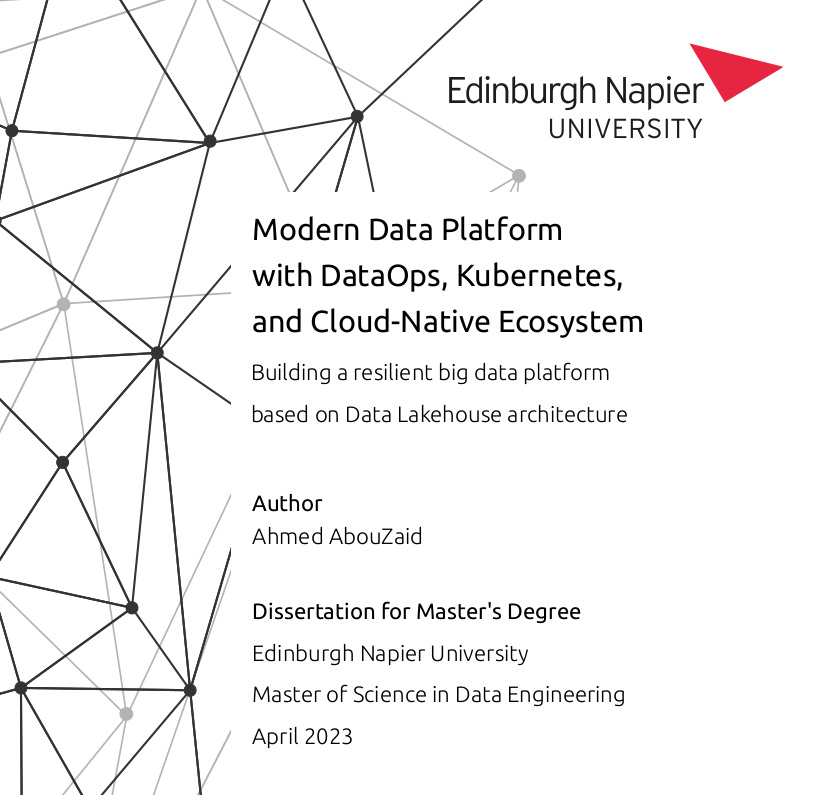
So today, I'd like to share my master's dissertation: Modern Data Platform with DataOps, Kubernetes, and Cloud-Native Ecosystem.

The dissertation builds a proof of concept for the core of Modern Data Platform using DataOps, Kubernetes, and Cloud-Native ecosystem to build a resilient Big Data platform based on Data Lakehouse architecture, which is the basis for Machine Learning (MLOps) and Artificial Intelligence (AIOps).

It was a super challenging topic, given the fact that Data Lakehouse architecture emerged just in 2020! But it was great to dive into it. I've been into data for years, and it's exciting to step up my skills from T-Shaped to Pi-Shaped (DevOps and DataOps) :-)

Continue Reading »

06/06/2023

Your DevOps learning roadmap is broken! - Career

...
⚠️ Update ⚠️
If you are looking for the solution for this dilemma, then check this out: How to become a DevOps Engineer in 2024 with the Dynamic DevOps Roadmap.
...

Can you read it? Probably not, it's already broken!

As of 2023, the DevOps Engineer role remains one of the top 10 most in-demand jobs across all industries (not just the tech field!) And that was the case for the last 5 years at least and is expected to continue for the foreseeable future.

While DevOps is a hot topic all the time, it's in particular hard to start DevOps engineer as your first job. Many engineers believe that it's not possible at all to begin as a DevOps professional without first working as a developer or in operations (I totally disagree with that!).

Almost every day, I see people struggling on their way to start as fresh/junior DevOps engineers. They usually follow some roadmap (typically roadmap.sh/devops). But still, they cannot land their first job, and sadly, many of them eventually give up!

This blog post explains why most of roadmaps don't work for DevOps roles and won't help you start your first job as a DevOps engineer. Also, the post discusses the best way to start in a DevOps role without prior work experience. While it might not work for everyone, I can say that it has been successful with all the people I have mentored in the last couple of years.


ToC

TL;DR

In 2023 starting a DevOps engineer role is challenging because the DevOps model has various implementations and patterns. It's even more complicated (but still possible) if that's your first job without previous software industry experience. Yet, many learning roadmaps like roadmap.sh/devops still follow a linear path (i.e., learn some topic to the end, then move to another, and so on) which doesn't work well with the DevOps role because a skilled DevOps engineer is a T-Shaped skilled. Adopting a dynamic MVP learning roadmap increases your chances of entering the market and starting your first job as a DevOps engineer without previous software hands-on experience.


DevOps Topologies

First, let's start with the DevOps model itself. Being a high-level methodology that can be implemented in various ways makes it super challenging. Hence, the DevOps engineer role has no unified definition or standard requirements.

I will not delve into the cliché DevOps is not a role, it is a culture (because in reality, it doesn't work like that! DevOps is not just a culture, and it is also a role), but here I want to emphasize that not all DevOps engineers are the same!

Here I want to mention "DevOps Topologies" which covers different team structures that implement DevOps. It shows many bad and good DevOps patterns.

Given that no one-size-fits-all team topology works for every organization, it's wrong to say it's not possible to start your career as a DevOps engineer. But there are situations where it's extremely challenging to do so, such as being the sole DevOps engineer in a team or even in a company.

So, what can you do to increase your chances of landing your first job as a DevOps engineer? You should have T-shaped skills and leave no stone unturned in your learning journey!

T-Shaped Skills

The "T-Shaped skills" helps DevOps engineers to efficivtly handle various challanges.

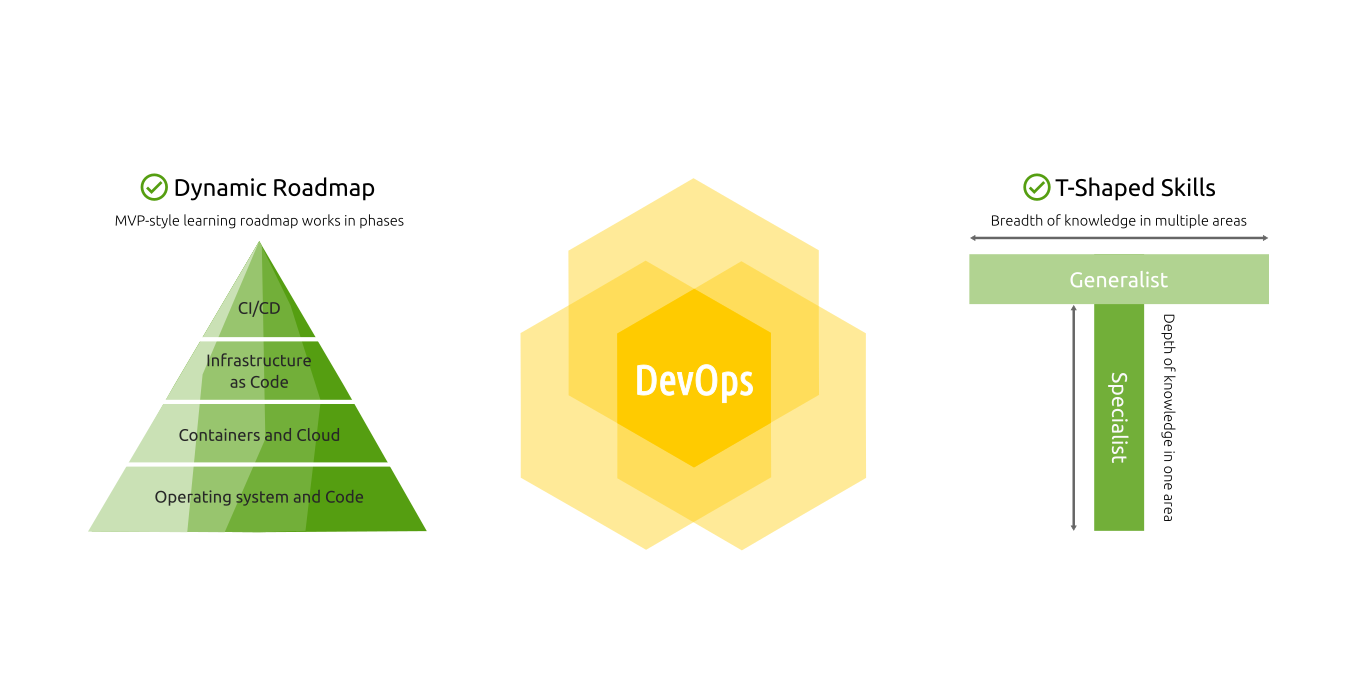
The T-shaped skills refer to combining broad and deep skills in a specific field. The horizontal bar of the "T" represents a broad range of general knowledge and skills across different disciplines or areas, and the vertical stem of the "T" represents deep expertise in a specific area. It's simply a mix between being a specialist and generalist at the same time!

The T-shaped skills will help you to work in companies with different DevOps patterns. You can easily transition between different areas in the DevOps spectrum. Not only that but also it will help you to handle new challenges effectively. In fact, the best DevOps engineers I have come across possessed T-shaped skills.

Does it mean there's no I-shaped DevOps engineer who specializes in certain areas and no little knowledge in other areas? I would say it's possible, but it may limit the available opportunities and companies you can work with.

Actually, as you progress in your career, it's better to develop more specialization (i.e., more vertical stems), and after a couple of years in the industry, your next step should be Pi-Shaped skills (search also for M-Shaped and Comb-Shaped skills, but it's a topic for another post).

To summarize this section, you should aim to gain exposure to various areas of DevOps practices and technologies without delving too deep into each one, yet, you need to dive in-depth into some of them (according to the market or organizations your target). And due to that, your roadmap shouldn't be linear but follow the MVP-style approach!

MVP Learning Roadmap

You probably heard before about the "Minimum Viable Product" or MVP, a basic version of a product with enough features to satisfy early users and gather feedback for further development, which's commonly associated with Agile methodologies. Interestingly, this approach can also be applied to learning roadmaps too!

Over the years, I saw people want to start their career as DevOps but completely lost! That's probably because they try to progress in a linear fashion. Typically they will follow some roadmap like roadmap.sh/devops and start learning the topics one by one top down. I.e., they spend a couple of weeks with Linux, then a month learning programming language, then some time with the containers, and more time with Kubernetes. And several months passed, and they found themselves stuck in the middle of the roadmap but still unable to get any job because many topics were untouched!

The truth is that the linear vertical learning path DOES NOT WORK in the DevOps field! You need to follow an MVP-style learning roadmap where you learn in iterations and touch multiple parts at the same time (not necessarily equally). Each iteration should focus on a primary topic while exploring related side topics. So after a month, you already know about each topic in the roadmap, and after the 2nd month, you have the basics, and after the 3rd month, you have a good base, and so on.

By adopting an MVP-style learning roadmap, you can ensure that you cover various aspects of DevOps while continuously building upon your knowledge. This approach allows for a more well-rounded understanding and a better chance of landing your first job as a DevOps engineer.

3 different high-level roadmaps models with different approaches to learning, the first two from the left follow the MVP-style, and the last one is linear.

  • The model on the left iterates horizontally in equal chunks over each area (good). It's simple and straightforward, each area (e.g., OS and code, containers and cloud, etc) has a fixed weight based on importance in the daily work. You don't need to think a lot about the next step, from the left to the right, you learn about each area and reach basic knowledge in all of them.

  • The model in the center iterates horizontally in dynamic chunks over each area (better). It's the same as the previous one but a bit more advanced, where it needs hands-on knowledge to decide the right weight for each area (based on many factors like targeted market or learner skills or background). This approach is more efficient; however, it requires guidance from an experienced DevOps engineer (e.g., a mentor or career coach) to define the weights correctly. It's even more critical when you have some sort of constraints like time or so (they are usually there in career shifts).

  • The model on the right iterates vertically over each area (bad). Don't do that! It has several drawbacks. For example, it delays your market fit, where in most cases, you cannot work as a DevOps engineer until you have completed all areas. Additionally, there is no space to review your learning approaches or holistic feedback in general. Finally, it's missing the connection between different areas, at the end of the day at work, you don't use a single skill at a time. I actually saw many disappointed people in the middle of the roadmap because they still didn't get the full picture.

So to ensure a more effective learning journey, it's recommended to adopt an MVP-style learning roadmap that allows for iterative learning across multiple areas while also considering the relevance and importance of each area in real-world DevOps work.

The Solution!

⭐ Check out the Dynamic Roadmap content ⭐

A dynamic MVP-style learning roadmap is one of the best ways to start as a DevOps engineer.

Let's put everything together. The Based on my experience mentoring people in different stages (starting their first job, career shift, moving to another work style or company), I have found that the approach of using a dynamic MVP-style roadmap with hands-on projects designed by an experienced DevOps engineer has been highly successful. That means each project will cover all DevOps areas used in the job. It's also essential to understand the targeted market and organizations because, with different DevOps topologies, the DevOps engineer role requirements vary.

In conclusion, to start working DevOps engineer, you don't need to know "everything" about the software development life cycle (SDLC), nor start as Dev or Ops and then switch to DevOps. In many DevOps topologies, you can secure your first job as a DevOps engineer if you invest enough time in learning (not only the technical aspects) and follow an MVP-style roadmap. Also, undoubtedly having a senior DevOps on both ends (during the learning and in the company where you apply) will make your start much easier.

Continue Reading »

31/12/2022

2022 Highlights


Just a random image generated with AI!

Finally, 2022 is over! What a crazy year! In many countries, the Covid-19 pandemic is about to come to an end, but a global economic recession is almost at the door!

On a personal level, it wasn't an easy year for sure, but it was good in many different ways.

Top 5 highlights in 2022

  1. Career: Started the Distribution team at Camunda 🤩️ which is responsible for building and deploying the Camunda Platform 8 Self-Managed (now using an umbrella [Helm chart). Later on, there will be a Kubernetes Operator. That's a great career boost; I just started with many new and exciting challenges. And BTW, my team will begin hiring in 2023!

  2. Coding for Kubernetes: Big refactoring for Bank-Vaults operator which is the biggest open-source contribution to a project I don't own/manage. It polished my Golang skills, and I learned many new things (and had fun where I redesigned the operator logo 😂️).

  3. Security Knowledge-sharing: In 2021, I got my CKS certificate. Then, at the beginning of 2022, I started a security initiative at Camunda to enhance security practices. Then, later on, I conducted a session about Kubernetes Security Best Practices (with some tips for the CKS exam) which was a great case that includes theory, applied practice, and knowledge-sharing!

  4. Advanced CI/CD Knowledge-sharing: I wrote a detailed post about my experience with custom step conditionalRetry, which handles failures on spot/preemptible infrastructure so you could save up to 90% of the costs and have stable builds as well! It's been released as open source, and you can use that in your pipeline!

  5. Activities: Helped more people in their careers, once by moderating the DevOps circle at [JobStack 2022, and also in the voluntary mentorship that I do from time to time.

Besides these highlights, I had some nice stuff during the year. For example:

  • Added more features to kubech (which is a tool to set kubectl context/namespace per shell/terminal )
  • Virtually attended KubeCon Europe 2022, and the content was great!
  • Reached my writing goal this year and wrote 12 blog posts in 2022!

And since we are on this topic, here are the top 5 visited blog posts in 2022!

Top 5 posts in 2022

  1. Delete a manifest from Kustomize base - Kubernetes

  2. 3 ways to customize off-the-shelf Helm charts with Kustomize - Kubernetes

  3. Validate, format, lint, secure, and test Terraform IaC - CI/CD

  4. Now I'm a Certified Kubernetes Application Developer + 10 exam tips

  5. Continuous Delivery and Maturity Model - DevOps

No wonder that Kustomize post is the hights post; that's because there is not much content about it even though it's built-in kubectl now! (since v1.14), I probably need to give it more attention since there is an increase in the demand for it.

For that reason, I just started Awesome Kustomize, which is a curated and collaborative list of awesome Kustomize resources 🎉️


Enjoy 🚀️

Continue Reading »

11/11/2022

27/07/2022

Notes about KRM Functions - Kustomize

Recently I dived into the new plugin system in Kustomize, KRM Functions, so I wanted to know more about it. Kubernetes Resource Model or KRM for short is simply a unified way to work with resources in Kubernetes ecosystem. For example, all plugins will have the same input and output format.

Here is a summary I found useful to share:

  • Kustomize decided to adapt KRM (Kubernetes Resource Model) functions from kpt ... and that's actually not new, it's been there for some time (around 2020).
  • The goal is to deprecate the old plugins style model. Kustomize already deprecated both Go Plugins and Exec plugins in favour of KRM style.
  • KRM Functions style has 2 ways for the plugins: Containerized KRM Functions and Exec KRM Functions.
  • The containerized KRM function is really useful one because you don't need to manage and download the Kustomize plugins (it was super annoying to manage plugins especially across multiple OS).

However, KRM functions are still alpha but look super promising, however, they are still buggy or incomplete for some use cases!

  • KRM exec has a bug which makes it almost unusable. In the PR no. #4654 I've a proposal to fix that issue.
  • KRM container has also some issues! It only works with KRM resources but not any external files (for example, if a plugin reads files from the disk, like creating ConfigMap from a text file, that will not work at the moment).

In May 2022, I decided to go a bit further and try to implement the KRM style to one of the existing plugins. So I've selected SopsSecretGenerator Kustomize plugin and introduced KRM support in the PR no. #32 So if you want to have an idea how KRM style looks like in action, then take a look at the change I made in that PR (It has been merged already).

In conclusion, KRM Functions look super promising but they are not that mature yet in Kustomize and they don't fit all the use cases.

Continue Reading »

02/07/2022

Kubernetes Security Best Practices with tips for the CKS exam - Presentation

At the end of last year (2021), and after a couple of years of Kubernetes production hands-on, I found that it was time to dive more into Kubernetes security, and after a lot of reading and practising, I got my CKS certificate. Also, for the last 3 quarters, security was one of the focus areas in my team, and I was taking care of it.

For that reason, I decided to consolidate that into a session which is a combination of Kubernetes Security Best Practices and tips for the Certified Kubernetes Security Specialist (CKS) exam to share the knowledge in my team as well across teams.

The session is just 15 Min in total. The first 6 Min are for everyone and the rest for Kubernetes specialists or anyone who wants to dive more into Kubernetes security topics. If you are just interested in the tools, then jump to section #5 Kubernetes Security Starter Kit. If you are just interested in the CKS exam tips, then jump to section #6 CKS Exam Overview and Tips.

Agenda:

  1. Introduction
  2. Shift-left and DevSecOps
  3. General Security Concepts
  4. The 4C's of Cloud Native Security
  5. Kubernetes Security Starter Kit
  6. CKS Exam Overview and Tips

Note: If you want more details about CKS, checkout my previous post for more info Now I'm a Certified Kubernetes Security Specialist + exam tips.


The recording of Kubernetes Security Best Practices session

Overview:

A dive into Kubernetes Security Best Practices and tips for the Certified Kubernetes Security Specialist (CKS) exam.

The 1-3 sections are for everyone and will cover the container era's security. So it doesn't matter your title or background; they are a good start for anyone.

The 4-6 sections will dive more into Kubernetes security, so DevOps engineers and SREs will probably find that more interesting. But in general, anyone interested in Kubernetes security is more than welcome.


That's it, enjoy :-)

Continue Reading »

22/06/2022

Moderating DevOps circle at JobStack 2022

Last Satruday (18.06.2022), I had a great chance to moderate and participate the DevOps circle in JobStack 2022 by Talents Arena. JobStack is the biggest virtual tech job fair in the region (MENA) and this was the 4rd edition.

With Hussein El-Sayed (Software engineer III at AWS) and Mohamed Radwan (Sr. Cloud Architect at T-Systems) ... we answered many different questions about DevOps. The circle or the AMA session was heavily based on a previous collaborative session between us in 2022 (DevOps! What, Why, and How? - Arabic)

The whole event was great and had a lot of fruitful sessions and discussions.

Continue Reading »

02/02/2022

Extending Jenkins to run resilient pipelines with long-running jobs - CI/CD

In 2021, I wrote a high-level blog post about how a small task force revamped and modernized a gigantic CI pipeline Which was an overview of the challenges we had while building advanced declarative pipelines.

In today's post, I dive more into the technical details and implementation and how we overcame long-running job limitations in Jenkins Declarative Pipelines.

Continue Reading »

12/12/2021

01/11/2021

Now I'm a Certified Kubernetes Security Specialist + exam tips

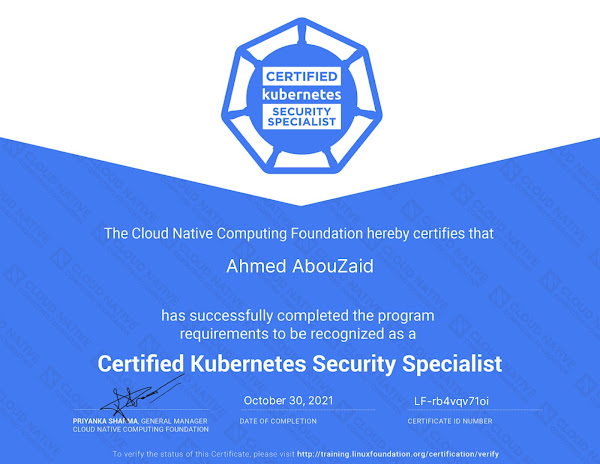
On Saturday 30.10.2021 and in less than 24 hours of the exam, I got an email that I passed the CKS exam on the first try and I'm now a Certified Kubernetes Security Specialist. So now I have the 3 Kubernetes certificates (CKA, CKAD, and CKS). 🎉🎉

So is it now DevSecOps? 😄️ Well ... let's take a look on some details about the "why" of getting a certificate.

Continue Reading »

11/09/2021

How a small task force revamped and modernized a gigantic CI pipeline - DevOps Transformation

One of the typical cases for DevOps transformation is when a team has the ownership of a component they shouldn't own in the first place. For example, when you have super complex CI/CD, and the developers don't manage the CI/CD jobs directly but with help from the operations team.

Let's imagine this scenario

Continue Reading »
Powered by Blogger.

Hello, my name is Ahmed AbouZaid, I'm a passionate Tech Lead DevOps Engineer. 👋

I specialize in Cloud-Native and Kubernetes. I'm also a Free/Open source geek and book author. My favorite topics are DevOps transformation, DevSecOps, automation, data, and metrics.

More about me ➡️

Contact Me

Name

Email *

Message *

Start Your DevOps Engineer Journey!

Start Your DevOps Engineer Journey!
Start your DevOps career for free the Agile way with the Dynamic DevOps Roadmap ⭐

My Latest Peer-reviewed Research Paper

My Latest Peer-reviewed Research Paper
Building a Modern Data Platform Based on the Data Lakehouse Architecture and Cloud-Native Ecosystem

Latest Post

10 Helm Chart Development Best Practices - Kubernetes

About 10 years ago, I used SaltStack extensively and wrote my top 10 best practices for SaltStack formulas . Today, I do the ...

Popular Posts

Blog Archive